Tuesday, September 3, 2013

Final Words

For those of you who have just stumbled upon this website, it contains a blog of the two years I spent working in India for an NGO called SELCO Foundation. I hope you enjoy reading about some of my experiences; the blog is now finished.

As I write this, my bags sit stacked in the corner and my apartment is looking almost as bare as when I arrived. It’s been a frantic last few days trying to sell all my things, tie up loose ends and say my goodbyes, but I’m finally there will be leaving this small town for good in just a few hours.

I realise it's been a while since my last post! The work with agricultural machinery has been moving along but at its normal, slow pace. Farmers are still very interested in the transplanter, but it seems it can take years before most will develop enough confidence in a machine to buy one, and it’s not yet even on the shelves for the more progressive farmers who are ready to buy one now. Even so, and despite various setbacks, we’ve just finished a relatively successful transplanting season, with more farmers beginning to trust the machine and some other organisations that work with farmers starting to look into taking it on.

Unfortunately I’m going to miss threshing season this year, but we’ve bought two new threshers (one from West Bengal and one from China) which will be tested shortly with farmers in Karnataka. If it either of them prove suitable, they will begin the same slow route the transplanter is now heading down, to raise awareness and make them more easily available.

Although SELCO’s main business is with rural home lighting systems, they do some larger solar installations for schools and institutions. I’ve been working on a project to branch into small wind, so that SELCO will be able to provide wind turbines as well as solar panels for these larger customers. We’ve recently installed a trial solar wind hybrid system in Chennai to try to learn more about how these things work, and how to go about installing them and we’re just starting to look for more customers. I’ve also been involved in a project to develop a low-cost datalogging anemometer (wind-speed measurer that can record data), which is just about finished now, and will help us to work out whether a site is suitable for a wind turbine.


There’s been a similar project to develop a SELCO solar water pumping product, mainly aimed at farmers without access to reliable electricity, which I’ve been quite heavily involved in. We have installed several systems already now and are planning to officially launch the product this month.


After three months of an unusually wet monsoon, the rains are beginning to relent and the clear skies have brought beautiful sunsets all week. I will miss a lot of things about Ujire, apart from its beauty: the treks in the forest, swimming in the rivers, motorbike rides through the Western Ghats, visiting farmers, watching flocks of huge fruit bats fill the sky, and the many friends I’ll leave behind. It has often felt like home, but I’m ready to move on. It has been a fascinating and enlightening experience, trying to cope as (normally) the only westerner in a small rural town, but it has been tough, and at times lonely.

As I head back to the UK, I feel it's right to take some time thinking and praying through my next steps before jumping into anything. When I first accepted the offer to join SELCO, it was not an easy choice knowing the sacrifices it would involve but I felt it was where God wanted me. I'm still amazed to look back and see the intricate ways God has used this chapter to teach me lessons I couldn't have learnt anywhere else and how he's used me to bless others so many times. I don't yet know what I will be doing next, but I believe that God has it planned out somehow.


                Lab meeting on Anand's farm


                Learning to harvest paddy by hand


                            A trip to Bandaje Falls with my sister and brother-in-
                            law when they came to visit.


                              Our catch after a day's fishing around Mangalore


                Trekking to Kudramukh Peak


Wednesday, September 5, 2012

Another Year


I’m back in India again after a brilliant month in the UK: getting to spend some quality time with my family, catch up with a lot of great friends and attend two weddings.

I’ve just been granted my visa extension, giving me another year in India and allowing me to finish my contract with SELCO. Getting the 40+ page paperwork together provided the usual adventure through Indian bureaucracy with multiple trips to the Foreigners Regional Registration Office and a slight moment of panic when they’d finally accepted my documents and I was told I needed to bring a bankers ‘demand draft’ for the payment by the next day or the application would be discarded, only to find out that most of the banks in Bangalore were on strike.

SELCO Foundation has just launched a Sustainable Energy Challenge (http://sustainableenergychallenge.org/) to encourage students in Bangalore to engage with issues of poverty and energy security, and hopefully give us some ideas for new projects we can start up. I gave a few talks at some universities in Bangalore during the launch and so, along with my need to be there for my visa application, I’ve spent a fair bit of time in Bangalore recently. This resulted in the first time in a long time that I’ve managed to make two consecutive church services, and I tried to make the most of being able to meet up with various church friends which has been a real blessing and I feel I’ve got to know people a lot better.

I also managed my first proper clubbing in Bangalore. All venues in Karnataka have to close by 11pm, as dictated by the rather draconian, right wing Hindu ruling party. This rule is interestingly very well enforced by the police, but it turned out one of our interns in the Bangalore office, Emmy, knew the right people and took us along to a private club at a hotel. It was still finished by 1.30 but we felt pretty cool/rebellious being out so late and certainly had a lot of fun.

I was welcomed back to Ujire by lots of rain and a mouldy flat. We’re pretty close to 100% humidity most of the time during the monsoon and everything, including books, clothes, walls and even furniture, develops a tendency to grow mould. It’s a constant battle during this period to keep things aerated and keep the moisture out so I was fully expecting to find things as they were, having not been able to fight it while back in the UK, but it was still a bit of a miserable reception.

We’ve got several new interns here at the moment including Seb and Graeme, two guys from the UK who are doing a placement through Engineers Without Borders, similar to the one I started out with here back in 2010. It’s nice to have so much activity again and lots of people to do stuff with in the evenings and weekends. I’d forgotten how much fun you can have just playing cards and board games, but without much else to do around town, they’ve taken a fairly prominent position in our social life.

I’m not planning to leave India for the next year or so now. It was strange to think, as I boarded the plane, that I wouldn’t be back for so long, although not nearly as daunting as I’d expected it would be. I’m feeling very settled here now and even though it may lack a lot of the comforts I’m used to in the UK, and I still find it difficult to communicate properly with a lot of people here, I feel somehow at home.


             Seb, Graeme, Vishal and me visiting one of the many local waterfalls


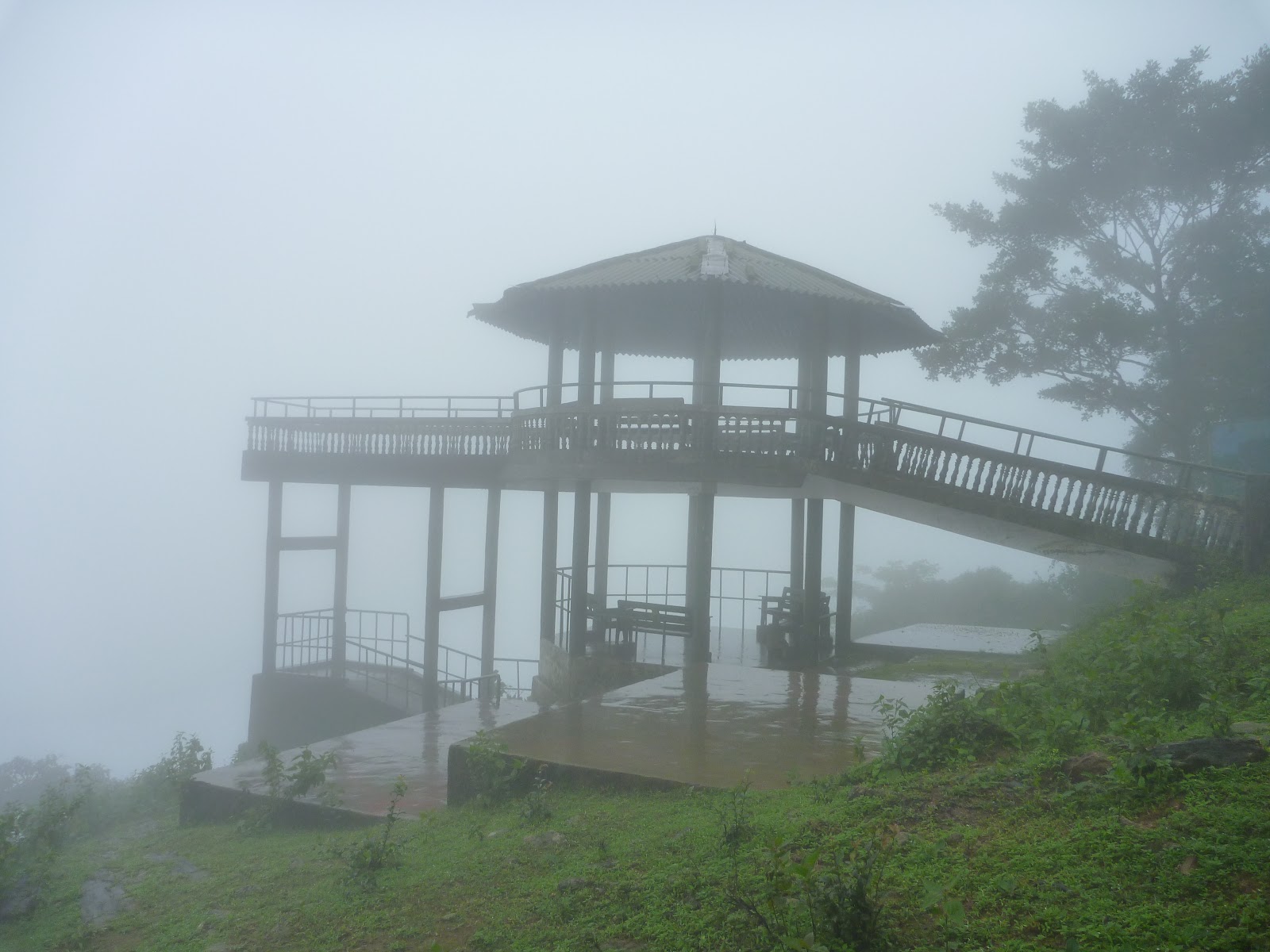
             Turns out we chose the wrong day to visit this viewpoint


I’d given the dehusker to a bunch of students to complete the manufacture and run some tests as part of their master’s project. This is them when they’d just finished the manufacture:


And this is rice that came through after the very first run. Actually a better rate of dehusking than I was expecting:


Seb has now taken on this project and is testing various materials for the dehusking plates; trying to maximise durability without compromising on the quality of dehusking.


             Here are some women using a manual areca dehusker that we were trialling


                            And here is a little girl having a go

Wednesday, April 25, 2012

Paddy Transplanter


I mentioned in my last post that one of the new things we’re looking at here is something called a “paddy transplanter”. Here's a bit of the background.

When a farmer grows his rice, he normally starts by intensively planting one corner of his field with seeds. After a few weeks, these sprout into lots of little seedlings which are too close together to thrive. The farmer then tills the rest of the field (churns it up to aerate it and kill weeds) and then uproots all the seedlings and plants them out with more appropriate spacing. This process gives the paddy a head-start over the weeds and the shock of transplanting causes the paddy to send out more shoots which increases the yield. This is the process you see rows of women doing, stooped over in fields.

As I’ve mentioned before, there’s a big labour shortage problem in Rural India at the moment. Paddy farming in particular requires a lot of labour, especially during transplanting, harvesting and threshing, and farmers are finding it increasingly difficult and expensive to find the labour to help them carry out these tasks. Large farms are now using large mechanical transplanters which are much faster at transplanting the seedlings, but are very expensive and not suited to small fields. Currently there is not a product on the market suited to small-scale farmers and so they are forced to pay higher prices for labour. These farmers are finding it more and more difficult to make enough money from growing paddy and so many are giving up on farming or turning to cash crops such as areca and rubber which make more money but aren’t as good at feeding the country.

Searching for machines already invented that might be suitable for small-scale farmers, we came across a manual transplanter which seems to be used in other rice-growing countries such as China but hasn’t made much of an appearance in India. In fact, there doesn’t seem to be anywhere in India manufacturing similar machines.

                             The transplanter at one of the earlier tests


We managed to find one place selling them (imported from China) and have had some fun showing it off at various agricultural shows since it arrived a couple of months ago. I’ve actually been very encouraged by the response of farmers, with literally crowds of them wanting to know when and how they can get hold of one. It’s also attracted a reasonable bit of media attention and has made it into a few newspapers (here and here) and local TV. Doordarshan, a national TV channel also recorded a little feature on us, so I may well have made it onto national television, but I didn’t unfortunately have a TV to check if we made the final cut!


As well as being considerably cheaper than any other mechanical transplanter, this machine is much easier to transport, more manoeuvrable, easier to operate and maintain because it doesn’t have a motor and doesn’t have any of the associate petrol costs. Trials so far have seemed promising, but we need to test it more rigorously in Indian conditions before we can begin to make it available to farmers. Plans are underway to get hold of some more of these and test them out with some farmers’ groups through a local NGO when the next transplanting season arrives in June.


I took a couple of days off over Easter and went to Kerala for a refreshing weekend at the beach with David and his flatmate, Kevin. This was my first break of more than one consecutive day since Christmas so I actually really needed it and it was great to be able to spend Easter with a couple of other Christians; we even conducted our own Easter service by the beach!


             Kevin catching a wave


             Trying to learn a bit more about transplanting from the pros

                          A local waterfall I visited with Roger and Headley before Roger left


Thursday, April 5, 2012

It's been a while...


I figured it’s probably about time for another update.

Roger left Ujire for the UK on Saturday night and I’m now once again the only Brit in the village. I’m also currently the only Westerner while Headley’s away in Bangalore. Headley (the American) is still technically based in Ujire, and living in an apartment just across from mine, but it looks like he’ll be spending around half his time away on work visits so this feels like the start of a new phase in my time here, with probably a very different lifestyle.

The temperature has been at times a struggle recently, with daily highs rarely lower than 37 C. The day after Roger left was poignantly marked by the first rains we’ve had in over three months; an early sign of the monsoon, which starts here in the South and finally brings an end to the hot season.

Day to day work hasn’t really changed much but some of the projects have really moved on: The next prototype of the paddy thresher has been a much bigger success than any previous model (thanks to some great work from Tommy, Roger and Anantha) and is showing a lot more potential for actually being helpful to the farmers; We have a new thing called a paddy transplanter which we’ve been demonstrating at various farms and agricultural shows and has had been received with a lot of excitement; I’ve been spending some more time looking into wind turbines and we’re currently putting together a plan for SELCO’s first (respectable) wind installation and the Lab has inadvertently made our first ever sale!

You won’t know what all of those things are but I plan to write about most of them in more detail so keep listening if any of it sounds interesting.

There are still unfortunately no English speaking churches around but I’ve been trying to make the most of my Sundays off with trips to nice or interesting places. I doubt I’ll be able to fill you in on all of these but some of the photos may make in onto Facebook. And there are some here too:


             Christmas breakfast at the beach. It really has been that long since my
             last blog entry!


             Our sand-snowman


             A very large statue. Every 12 years Hindus construct this scaffolding around
             it, cover it in fancy decorations and ‘bathe’ it in various different substances

             A standard Jeep ride. Guess which one's driving the thing...


                         A work trek to Bandaji Falls


             Bandaji Falls


             Having a go at some pottery


             Having a go at the local 'lift a really heavy rock' competition


             The earth terminal in our apartment block seems to have an interesting
             tendency to float at around 50-60 Volts AC. For those of you who
             aren't electrically minded: it's not supposed to do that and means that
             most metallic electrical appliances give you an electric shock when you
             touch them.

Wednesday, December 21, 2011

Chitradurga

SELCO has traditionally almost exclusively sold personal photovoltaic systems: they have come up with various innovative ways to help people afford the systems and acquire loans, but the product has always been the same. SELCO Labs, the division I’m a part of, is only a couple of years old and is essentially the ‘innovations’ department, developing new products and services. Last week I visited Chitradurga, a district renowned for its high wind speeds, to scope out locations for SELCO to trial wind turbine systems and some of the other projects we’re working on, so this is probably a good point to fill you in on some of the our other work...

In the past, SELCO have been highly praised for our ability to provide for people in slums, but slums are still a notoriously difficult market to reach and there are many locations where the standard SELCO model just can’t work. The dwellers generally don’t own the land and can be moved on at any time, so they are unwilling to invest in anything which cannot be easily transported if needed. On top of this, if the landlords see that the people are establishing themselves (and investing in things like electricity), they will often kick the people off to stop them getting too settled. Banks are also unwilling to lend money to people without a fixed address. The biggest electricity need of these people is lighting, to replace their dim and unhealthy kerosene lamps and so one new model from SELCO Labs, which has been pretty successful so far, is to rent out electric lanterns. SELCO find a local entrepreneur who is willing to manage a central charging station and then the people pay a certain amount each day to rent their lighting. The guys from this unelectrified roadside slum seemed interested in the program so hopefully they’ll have lighting soon if everything works out.


Another project we’re investigating is how to implement mini-grid systems to power a cluster of houses from a central power station. Large photovoltaic systems are cheaper per watt of power and so these systems can offer reasonable cost reductions, however they come with a whole host of social issues to overcome, such as how do you decide who pays what and who covers maintenance, how much electricity can each person use, how do you prevent people bypassing their meter etc. We are yet to set up any mini-grids, but this rural slum could be a great location for our first trial. The guys don’t currently have legal rights to the land, but apparently they have been granted ownership and will be looking to upgrade their dwellings once the paperwork comes through. Being in such a windy location, this may also be a great site to put a wind turbine further down the line as these guys’ electricity requirements increase.


This remote village only got a (dirt) road to it a few years ago and is still very underdeveloped. The villagers are subsistence farmers and only receive an income twice a year, when they take particular harvests to market, and so banks are unwilling to lend them money even though they own their land. We managed to arrange for some of them to get our systems a couple of years ago and we’re now trying to find some way the others can manage to afford them.


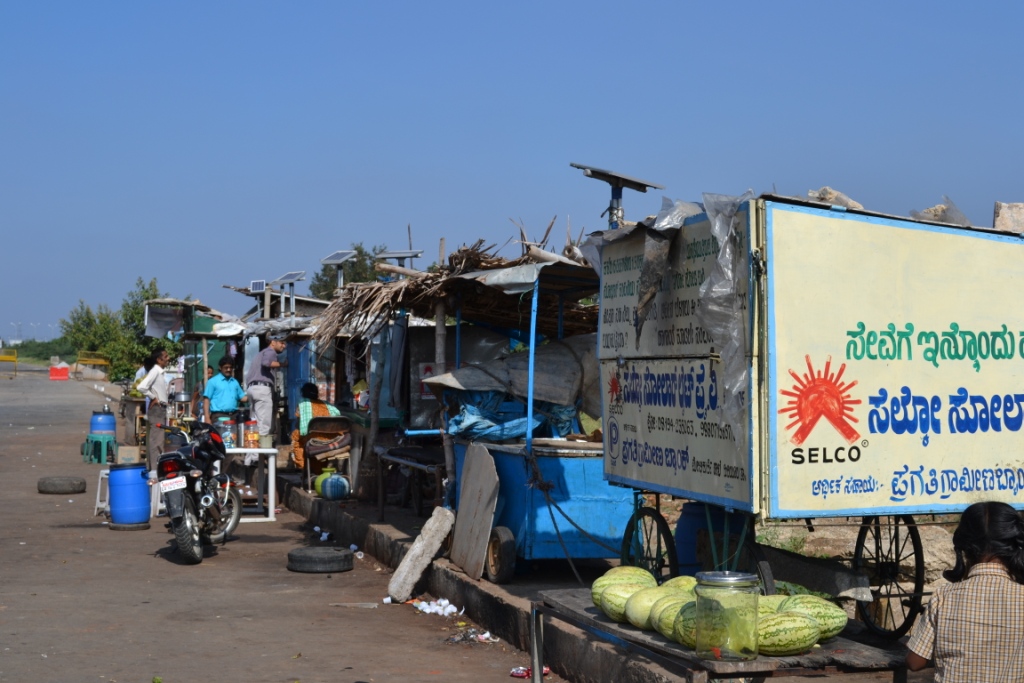
Whilst driving around Chitradurga, we also stopped off at this example of some of SELCO’s standard systems which have allowed street sellers to operate at night and increase their income (you can see the little solar panels sticking up from the carts). The guy nearest is obviously such a big fan of SELCO that he’s painted our logo on his cart!


And here’s one final project I visited whilst in Chitradurga: a (probably) one off project to kit a school bus out with laptops and solar panels, which will then be carted around a cluster of schools running IT classes for the students. This seems like a great project and the computer skills taught should open up a load of opportunities for the kids, but unfortunately it’s difficult to do these kinds of projects without donor funding, like we had for this one, as there is no revenue to make it self-sufficient.


I got a chance to visit the famous Chitradurga Fort whilst there, an impressive structure with seven concentric rings of fortification. This is also home to 'the human monkey', who was originally thought mad when he made his home in the walls but has now become a media sensation for his impressive climbing skills. This is him abseiling down one of the walls without any ropes; leaving the wall entirely as he drops several feet at a time between hand-holds.


Unsurprisingly, he's developed a bit of a following and this is one of his 'students' who clearly still has a bit to learn as he hangs on only with the help of some others.


Before I got to Ujire, the lab took on a project with a university economics professor who had designed a vertical axis wind turbine and wanted us to help him test it. At the time we agreed to it, there was unfortunately no-one around in the lab who knew enough about wind turbines to realise that the guys didn't know what they were doing and the turbine is pretty much a piece of junk. It's been something of a dark shadow in the lab ever since. Tommy and I have finally got round to getting a stand made for it, found potentially the windiest site in the area (which still isn’t saying much and it's pretty difficult to get away from trees here!) and put it all together and installed it. After a few modifications, it now turns, but we’re yet to see if it will generate any worthwhile power and it certainly won’t reach the 108% efficiency which the designers have somehow predicted in their calculations!


We were visited by a group of 25 entrepreneurs who all own solar companies in various different parts of Africa. Our lab hosted them for the last day of their five day, NGO funded, trip to India to learn more about how SELCO works and get advice for how they can run things in their own countries. In the evening we organised a meal followed by a traditional local dance/play. The play was quite good fun and involved some impressive costumes, although with everything spoken in Kannada and without much actual movement onstage, even the two and a half hour shortened version was a bit much for me and Tommy (the original is supposed to take over eight hours!) and we left early. Apparently by the end there were no Africans around either...


This will probably be my last blog post before Christmas so I wish you all a very merry and significant Christmas! In India, Christmas is celebrated, but it’s just one more occasion in a multitude of different festivals that happen throughout the year. There are some plastic stars for sale in some of the shops at the moment and I saw a van driving around the other day playing loud Indian music with some guys dressed as Father Christmas with green facepaint standing in the back, but apart from these odd things there's nothing to let you know it’s only a few days away. And it’s difficult to feel Christmassy when the temperature is still reaching 35 degrees most days! For someone who’s always felt so disillusioned by the superficial and commercial Christmases of the West, I’m amazed at how much I miss all the festivities and the lights and the buzz. Tommy, Roger and I are planning to take a few days off work and head to the beach for our Christmas. We’ve booked our train tickets, although all the lodges we've called seems to be either fully booked or just tell us to turn up on the day so we’ll just have to try the latter and see what happens.

That pretty much concludes the blog but here are a few other photos:

                         There were also some real monkeys at the fort


             They hadn't quite finished loading the roof of our nightbus when I took this
             photo. I was assured that the roofs are designed to take this kind of weight,
             but the constant swaying/shearing motion on the way back was a bit
             disconcerting. And we did get two punctures...

             Some wind turbines around Chitradurga

             And some slum puppies


Thursday, December 8, 2011

Movember


It seems like there aren’t many weeks that go by without some kind of festival or celebration here in India, but last week held Lakshadeepa, one of the larger ones in this region. It’s another festival of light and is famously celebrated in Dharmasthala, the next town along, with a four day carnival which thousands flock to from the surrounding area. The streets become filled with various stalls and entertainments (including a rather perilous looking funfair) and the whole town is covered in tiny lightbulbs. I ended up spending a reasonable bit of time there helping to man the SELCO stall, which was mainly advertising our solar lighting systems but we had a bit showing off some agricultural machines too in the hope of catching some farmers to talk to.

Tommy, Roger and I decided to partake in Movember this year. I would love to say that we did our bit in raising awareness for men’s health issues but unfortunately, with about 90% of the blokes here sporting a tash, I think our efforts were slightly lost in translation. Before finally shaving it off, I thought it would be sensible to get my moustache professionally trimmed. And I figured there were probably few places in the world more experienced at doing it than a South Indian barber’s. I was indeed very impressed with my 25 rupee cut (about 35p), which left my tash in top shape and came with a free (very vigorous) head massage, about 6 different face ointments, and no cuts!


The design for the next prototype of the thresher is now finished and it’s ready to be built. As of yet we’ve always used workshops in Ujire to do the fabrication for prototypes but they can be quite slow and aren’t great at more detailed parts so as the designs start to get more advanced we need to investigate new options. Mangalore is a much larger city and holds lots of workshops which are ideal for the kind of work we need but many of these larger places are only interested in big orders so it can be tough to find workshops willing to make one-off prototypes. I needed to get some bearings and pulleys from Mangalore last Wednesday so I took the opportunity to search out somewhere to get our thresher made and through a suggestion from one of SELCO's contacts managed to find a workshop willing. It's run by a qualified mechanical engineer who seems very interested in our projects and keen to be involved (and also speaks good English which simplifies things a lot) so if it all works out this could make manufacturing a lot easier in the future.

At the weekend I had to make another trip to Bangalore to open a bank account and got to spend a nice bit of time with David and Kevin again. The bank I was recommended is everything you expect and Indian bank should be: a chaotic, stuffy room with barricades of women at desks which you need to navigate before you can get anything done, endless forms and run on an archaic system of paper and floppy disks (that's not actually a joke: there were stacks of paper and genuine floppy disks all over the clerks' desks). In order to open a bank account, you need to be proposed by someone already holding an account with that bank (as well as provide all the letters and other pieces of paperwork of course), but the bank manager had kindly agreed to propose me when I visited on a previous trip to Bangalore so that wasn't too much of a problem in the end. What was more of an issue was that due to a technical fault, a large number of people could't withdraw any money from the ATMs that day and so were coming into the bank to get their cash. And the protocol seems to be that it is the bank managers job to deal with withdrawals so I ended up stuck in his office for over two hours while he tried to complete my paperwork amid dishing out payments of anything from £10 upwards to disgruntled customers and running the bank. Anyway, I now have my very own Indian bank account which feels quite cool; let's hope the bank doesn't lose all my money!

-Oh, and I've made it into my first Indian paper (click here), which is published all over Karnataka. I'll try to get in one that's written in English next time though...


             Now that we've kitted the kitchen out, we've been cooking a bit more for
             ourselves. This is an attempt at pasta sauce: difficult without any herbs but
             it just about works.


And some other photos...


             One of the thresher tests rained off


             A farmer's kids collecting tender coconuts for us to drink


                           An ox


             And a little chick